
A small-business website must first complete the visitor’s path. Clear writing and attractive design matter, but neither can compensate for a path that ends at a missing page, an unclear offer, or a contact action that does not work.
That conclusion came from a detailed evaluation of JerryGBooks.net. The site had assets many businesses struggle to create: a recognizable author voice, a personal story, and a developed story world around Aragost. The review still scored the experience at 64 out of 100 because several high-intent routes were incomplete. Visitors could encounter references to the library, books, purchasing, contact, or engagement and then reach a weak or broken destination.
The problem was not “the site needs more content.” It was that the existing content did not consistently carry a reader from interest to action.
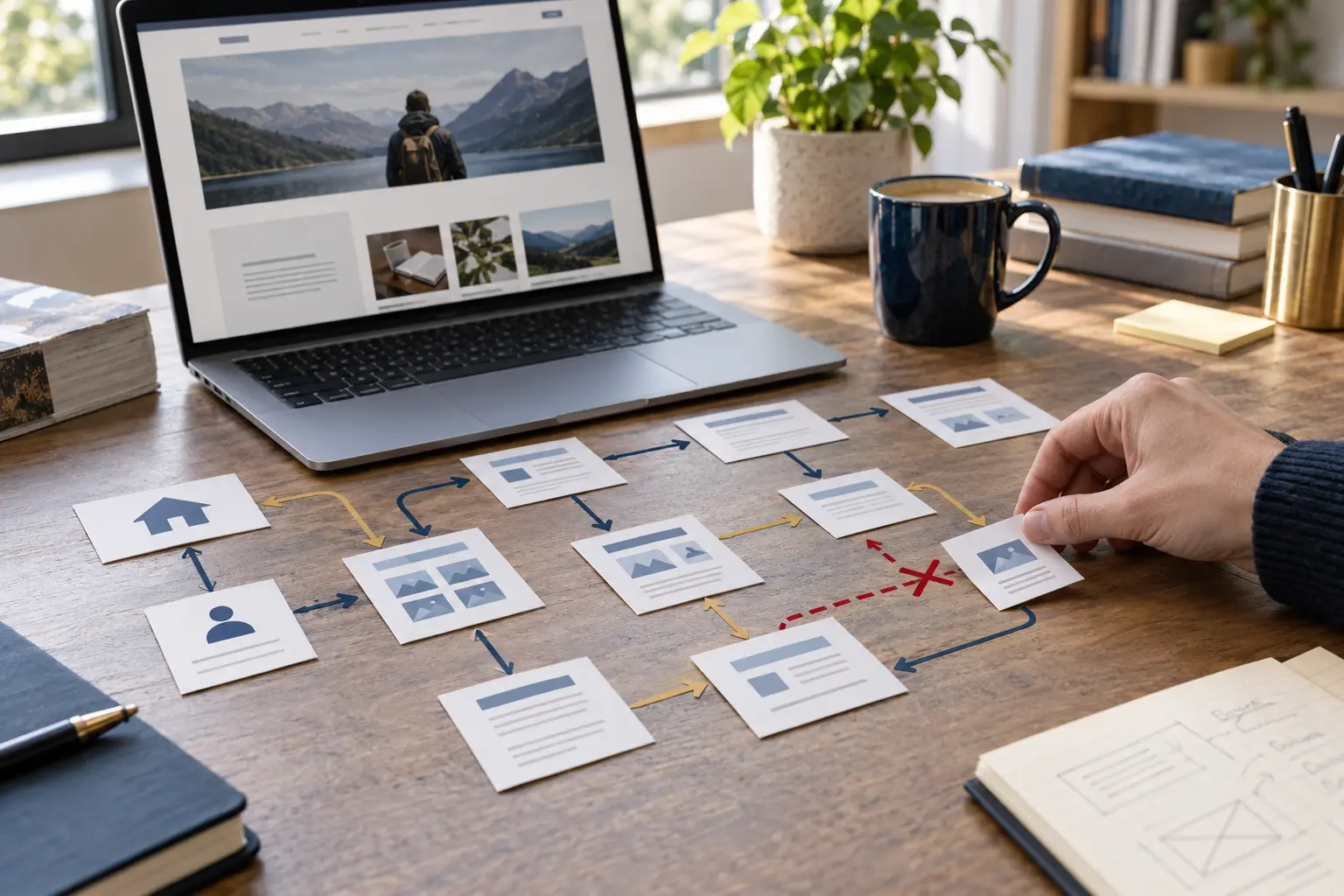
Organize the Site Around the Visitor’s Decision
The audit changed the priority order. The memoir needed to become the primary product rather than one item competing with every other idea. Navigation needed to reflect reader decisions: learn about the book, understand the author, enter the story world, purchase, or make contact.
That is a more useful test than counting pages. A five-page site with complete pathways can outperform a 30-page site that repeatedly asks the visitor to start over.
For each important page, a small business should be able to name:
- the visitor who needs it;
- the question that brought that visitor there;
- the proof needed before the visitor trusts the answer;
- the next action;
- the destination that completes that action.
The last item is often missed. A button is not a complete pathway. The page it opens, the information it requests, and the response that follows are part of the website experience.
Build Proof Into the Decision Path
The same lesson appears in The Cintman Group’s own site architecture review. Services, Our Work, and Case Studies had to answer different questions. Services explains what the studio can do. Our Work shows whether it has done relevant work. Case Studies explains how the problem was approached and where value was created.
When those functions overlap, visitors must interpret the company’s internal taxonomy. When they are distinct and connected, proof appears where the purchase decision requires it.
Enterprise websites can assign these issues to content strategy, user experience, development, analytics, legal, and operations teams. A small business may have one person maintaining everything. That makes reusable page patterns, complete links, consistent contact identity, and clear ownership even more important.
The Cintman Group, a local San Antonio generative AI studio, treats a website as an operating system for visitor decisions—not a collection of pages. The first responsibility is to connect a real visitor need to a complete, credible next step.
This also changes how redesign priorities are discussed. “Add a portfolio” becomes “place relevant proof beside the service decision.” “Improve the contact page” becomes “make the handoff from interest to inquiry complete and consistent.” The language becomes operational because every recommendation points to a visitor action the business can inspect.
Before adding another feature, trace the three most important journeys from the home page to their final destinations. If any journey breaks, fixing that pathway will usually create more value than adding another page.
Trace the visitor path before redesigning the page. Review The Cintman Group’s website services.

The Cintman Group